

At a recent event at the wonderful One More Chapter bookshop, I was asked several questions about the worldbuilding in The Last Vigilant, and specifically about the map at the front of the book and how closely it ties into the creation of Aelderland.
This is a topic that I’m very passionate about, because I’m a massive map geek! The answer is that the world pretty much began with maps! It’s probably down to all my years running tabletop RPGs that for me, a setting only becomes real once it’s been mapped. In fact, years ago I designed a world map for what I hoped would become an original TTRPG, but never actually did anything with it. The map looked like this:
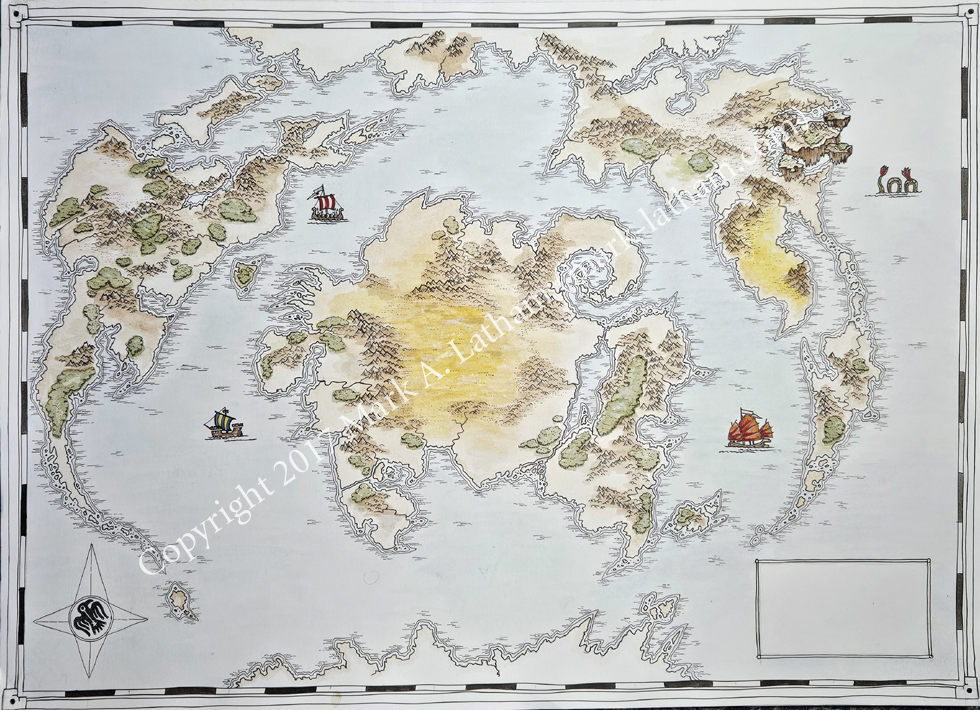
Obviously it took a lot of sketches and iterations before I committed to an actual A2-sized painted map. Some of the map features are very “high fantasy” (it’s literally got a continent shaped like a dragon…), but I was very happy with the result. The important thing here, however, is that when I started coming up with names for the various realms, the continent on the left was called “Erevale”, and one of the kingdoms in the middle of Erevale was “Aelderland”. Something about those places struck a chord, and so when I started writing my first epic fantasy book, I decided to take those names and transplant them into The Last Vigilant.
I had a basic idea for the story I wanted to tell, and I knew I wanted to keep the action confined to just a small area of the kingdom of Aelderland. But it was still very important to me to understand the kingdom as a whole – its geography, its regions, its close neighbours. All that would then inform Aelderland’s people, its economy, its technological level… so I had to start sketching out the kingdom. It started with a really rough area map, divided into seven counties (originally, I called these “Shires”, but to avoid comparisons to Tolkien – and real-world England – I landed on “mearcas”, loosely based on the Old English concept of a rough boundary or marked-out space).
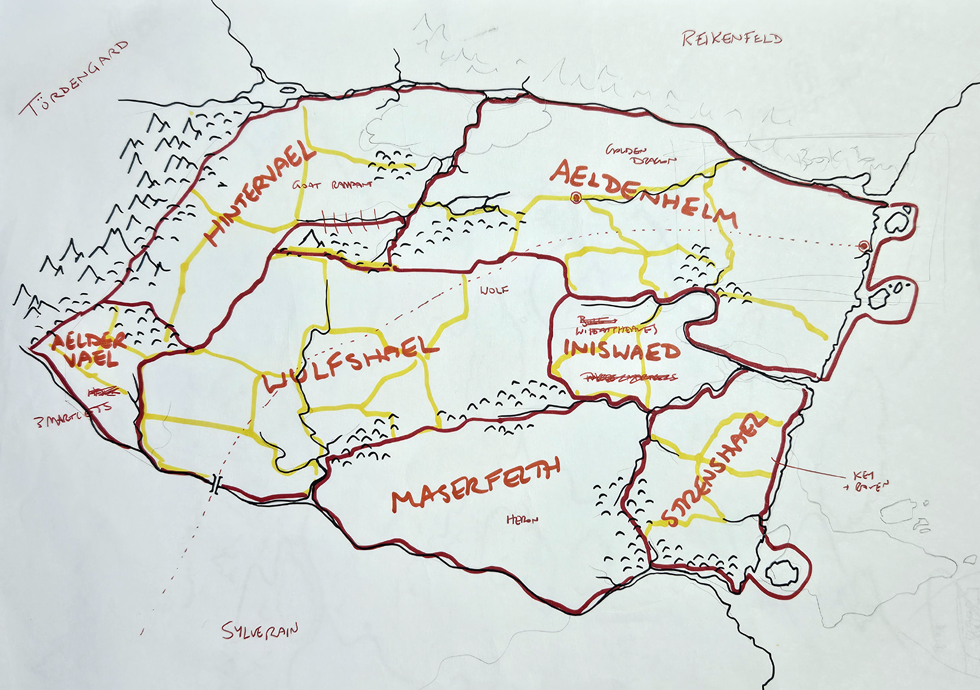
After much deliberation, I eventually settled on the area where the action of the novel would take place. A slice of the western part of the country, encompassing roughly half of Wulfshael and a sliver of Hintervael. I decided that Aelderland’s (somewhat Gallic) southern neighbour, Sylverain, would be part of the story, and so I extended the map all the way south to the Sylven border.
This got me to thinking a lot about the makeup of the kingdom. It’s no great secret that Aelderland is analogous to England and Wales in the Middle Ages (roughly around 1000 AD). With that concept in mind, I began to work out what the features of each mearca might be, the trades, the people, the regional dialects and accents. It made sense that Holt Hawley would hail from somewhere near the mapped region, and I opted for Hintervael, which I decided would be a very large, mountainous area with similarities to our own North Yorkshire, Northumberland, and Cumbria. Wulfshael, being similarly vast, would have similarities with the real-world South Yorkshire, Nottinghamshire, and Lancashire.
(An interesting aside – this is a quasi-medieval feudal culture, so people really don’t travel very much. A peasant from the far south of Wulfshael would have little in common with their counterpart from the far north of the same mearca).
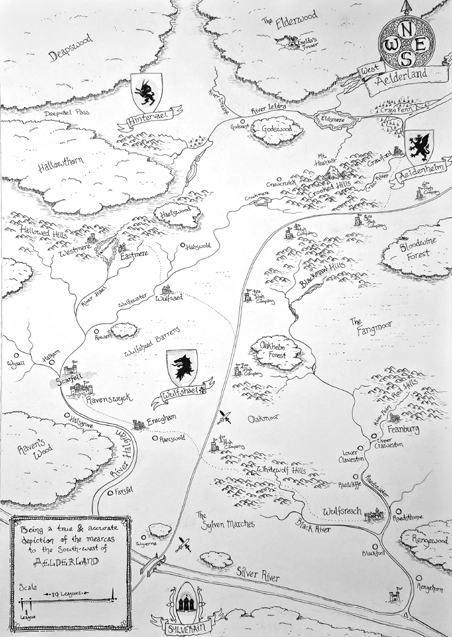
Once the map was refined a little, and the key locations were locked in place in my mind’s eye, it actually began to shape the story. The locations became real to me, and therefore the distances between them and the scenery they traversed along the way had to be factored in when my characters travelled from A to B. I made a scale for the map, and (mostly) stuck to it, bearing in mind that medieval map-making wasn’t the most accurate…
And eventually, I was in a position to draw the map properly. This was long before I sold The Last Vigilant to Orbit Books, so I was able to take my time and make this map more detailed than it ever needed to be. As I said, I’m a bit obsessed with maps, and I have a lot of practice at making them for my TTRPG campaigns. I drew the map with pencils on an A2 board, taking some tips from the very cool book How to Draw Fantasy Art & RPG Maps by Jared Blando. Once I’d refined the pencils, I inked the whole thing, and ended up with this:
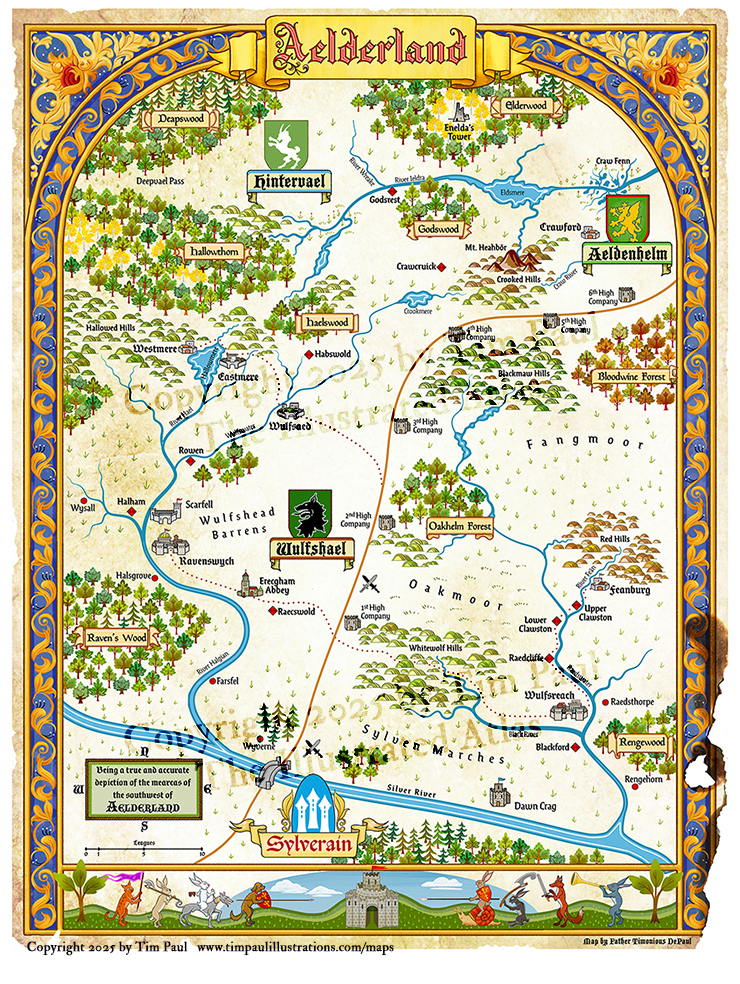
And that was it for a time. Once Orbit took on the book and began to prepare for publication, they asked if I wanted a map, and so I sent over what I had (they were somewhat surprised by the detail of it…). They then sent that, plus extra notes, to map illustrator extraordinaire Tim Paul. Tim started with a clean trace of my map for reference (and he was very complimentary about my cartography skills, which was most gratifying coming from a pro!), and then much discussion ensued about the precise locations of villages, forests, rivers, forts, etc. when compared to the final text of the novel, along with the exact spellings of place names and so on for the labels. Once the details were locked down, Tim created his excellent version of the map, complete with heraldry and those wonderful medieval-esque borders featuring anthropomorphic characters. With very few tweaks, this map made it into the book – but what most people don’t know is that Tim also created a full-colour version, which really is a work of art. All of that early work led to the creation of this beauty:
It doesn’t end there. The second book in the series will be out later this year, and as it’s set in a different part of Aelderland, I once again began with maps. In fact, I’m really hoping Tim will be the guy to take on the map of Helmspire, the largest city in Erevale, with all of its opulent avenues, crumbling grandeur, and dark, dangerous alleyways. The evolution of that particular map will be the subject of a future post. For now, I hope this has given you a peek behind the curtain at my worldbuilding process, and I look forward to expanding Aelderland – and the rest of the world – as the series progresses!




Leave A Comment